

How AI Is Changing Daily Life for Blind and Low-Vision People
Artificial intelligence is quietly reshaping everyday life for blind and low-vision people — reading text aloud, describing surroundings, recognizing faces and objects, and helping with navigation. Here's what's changing, why now, and where SparkVision fits in.
- accessibility
- ai
For people who are blind or have low vision, some of the most ordinary daily tasks — reading a letter, checking whether the milk has expired, finding the right door in an unfamiliar building — have always required help from someone else. That's changing, and the reason is artificial intelligence. AI is quietly working its way into the tools people use every day, turning what used to need a sighted helper into something a person can do on their own.
What AI actually changes
AI's real contribution is understanding the messy, real world and describing it in words. A camera paired with an AI model can now look at a page and read it aloud, look at a room and describe what's there, or look at a product and identify it. The same intelligence powers smarter voice assistants, more natural text-to-speech, and apps that can answer spoken questions about a photo or a scene. In short, AI gives everyday devices the ability to see on your behalf and explain what they see.
Real moments where it helps
The value shows up in small, everyday moments:
- Reading post, bills, and handwritten notes without waiting for a sighted helper.
- Checking expiry dates, cooking instructions, and medicine labels in the kitchen.
- Identifying banknotes and coins when paying in a shop.
- Recognizing a familiar face, or knowing who just walked into the room.
- Getting your bearings in a new place — a station, a hotel, an office corridor.
- Asking out loud "what's in front of me?" and getting a useful answer.
None of these is dramatic on its own. Together, they add up to something that matters a great deal: doing ordinary things on your own schedule, without having to ask.
Why now
AI like this existed for years, but it was slow, clumsy, and often wrong. Recent advances changed that. Modern AI describes scenes faster, more accurately, and in language that sounds natural rather than robotic. It copes with messy handwriting, poor lighting, and follow-up questions, and it runs on lighter, more affordable devices. The result is that AI assistance has crossed the line from "interesting demo" to "tool you can actually rely on every day."
Where SparkVision fits
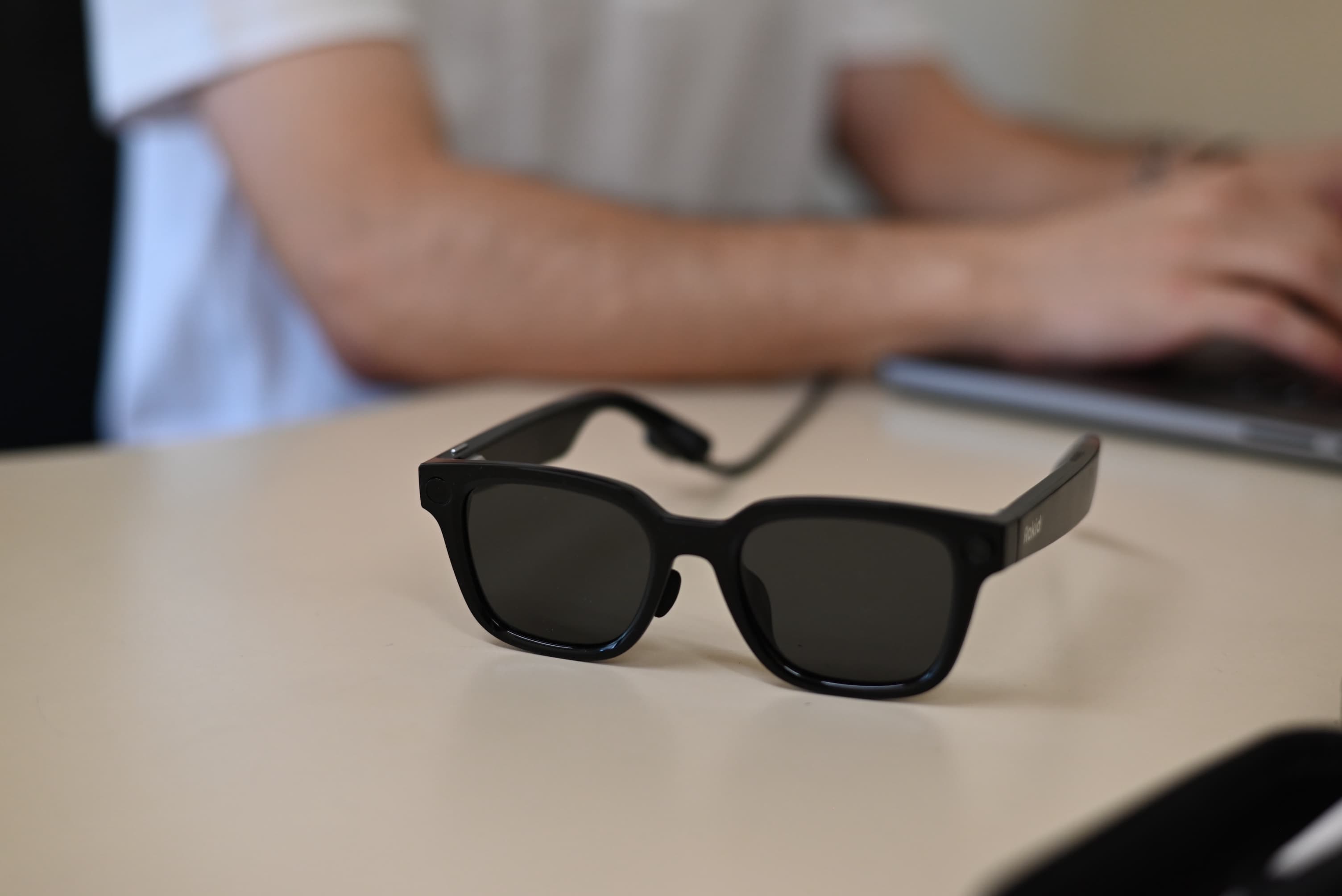
This is the problem SparkVision Glasses 2 Ultra was built to solve. They look like an ordinary pair of lightweight black glasses — around 38 grams — but a 12 MP camera and four directional microphones sit around your point of view, and the idea is simple: point, press, and listen. The glasses read printed text aloud, from a single label to several pages at once, and can tell you the ingredients, allergens, and expiry information on a product, the store name and total on a receipt, or an estimated count of the banknotes in your hand. Color recognition helps tell similar clothes apart, environment description gives spoken context about a room or a street, and the built-in AI assistant answers questions about what's in front of you. When a moment is more complex, you can start a call with a trusted person and share your point of view. The Ultra tier adds a navigation assistant and a public transport assistant, with unlimited AI and up to twelve hours on the included battery pack — all controlled by swiping the frame, pressing the temple, or using the SparkVision Smart Ring, whichever is most discreet for you.
The bigger picture
AI works best as assistive technology when it disappears into the background and just lets people get on with their day. That's the direction the whole field is moving — and the standard we hold ourselves to. On this blog we'll keep covering developments in AI, vision technology, and accessibility from around the world, alongside news from SparkVision, so you always know what's possible.